ECU tuning and performance optimization by Codiag Lab
Engine Control • Performance Software

ECU Tuning

Professional ECU calibration for more power,
torque and driving enjoyment.

What is ECU tuning?

The software behind engine performance

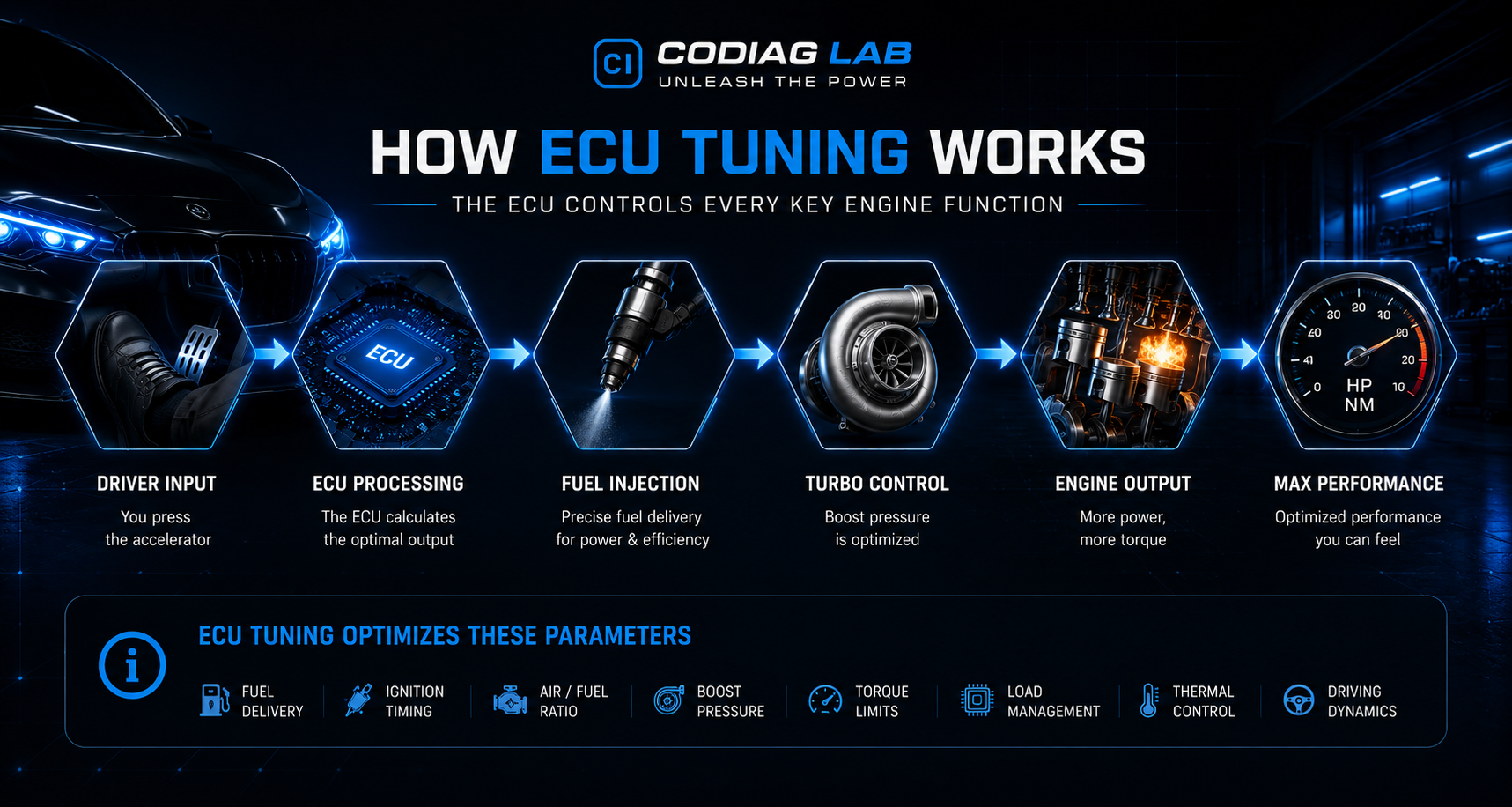
The Engine Control Unit is the digital brain of the vehicle. It controls how the engine responds to the accelerator pedal, how much fuel is injected, how boost pressure is managed, how torque is requested and how safety limits are applied.

Factory software must work across many markets, fuel qualities, climates and driver profiles. Because of that, manufacturers often leave a significant performance reserve in the original calibration. ECU tuning uses professional software optimization to unlock part of this reserve without replacing mechanical components.

Fuel injection controlTurbo boost managementTorque request strategyThrottle response behavior
How ECU tuning works infographic
Factory vs Optimized

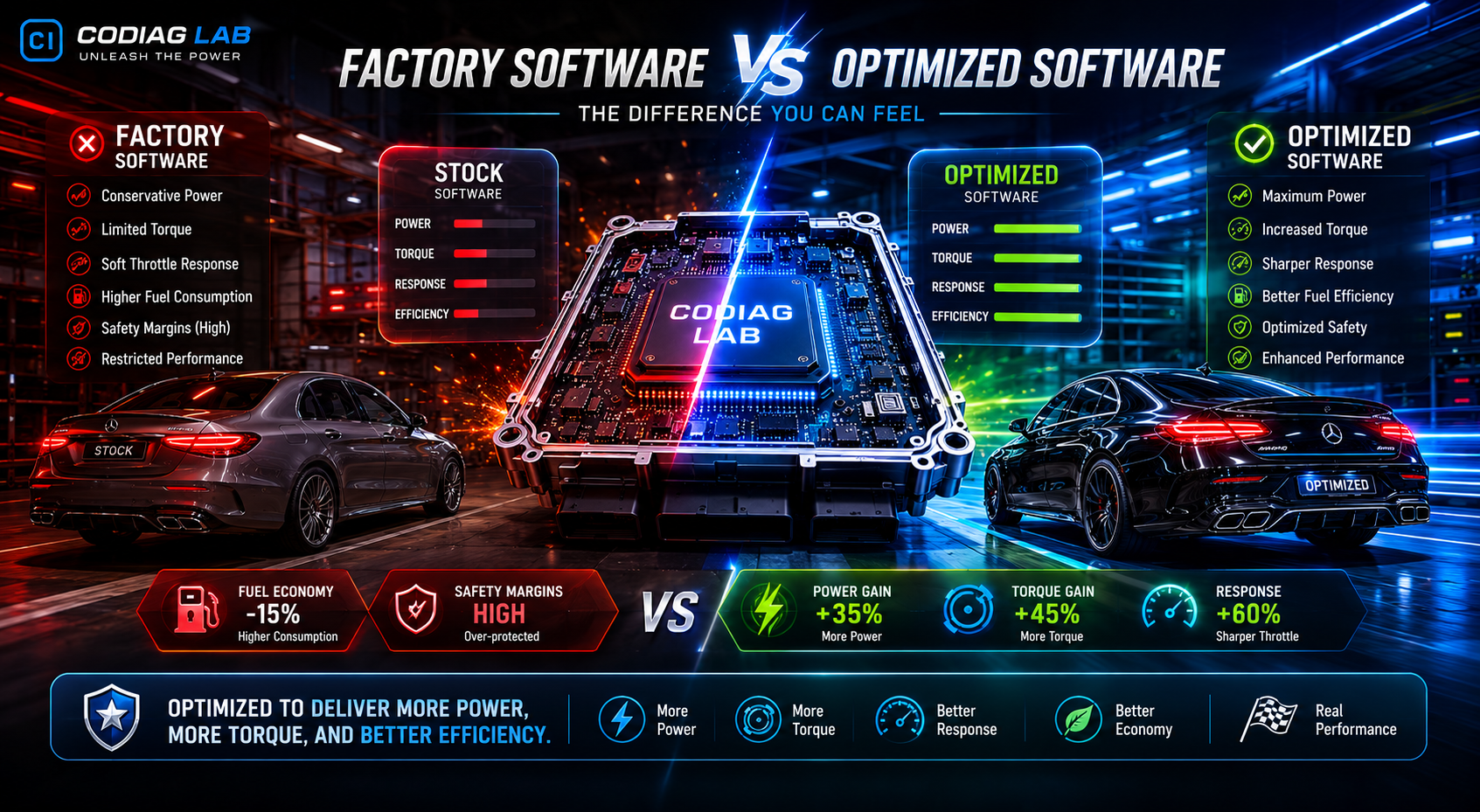
More than numbers — a different driving feel

An optimized calibration focuses on your vehicle’s real potential, not only on the conservative global factory setup.

Factory software vs optimized software comparison
Feature
Factory
Optimized
Result
Daily feel
Focus
Power delivery
Conservative
Enhanced
More usable output
Stronger acceleration
Performance
Torque response
Limited
Improved
Higher pulling power
Less downshifting
Drivability
Throttle behavior
Soft
Sharper
Faster reaction
More direct control
Response
Power delivery
Factory Conservative
Optimized Enhanced
Result More usable output
Daily feel Stronger acceleration
Focus Performance
Torque response
Factory Limited
Optimized Improved
Result Higher pulling power
Daily feel Less downshifting
Focus Drivability
Throttle behavior
Factory Soft
Optimized Sharper
Result Faster reaction
Daily feel More direct control
Focus Response
Real performance examples

Performance results that are easy to understand

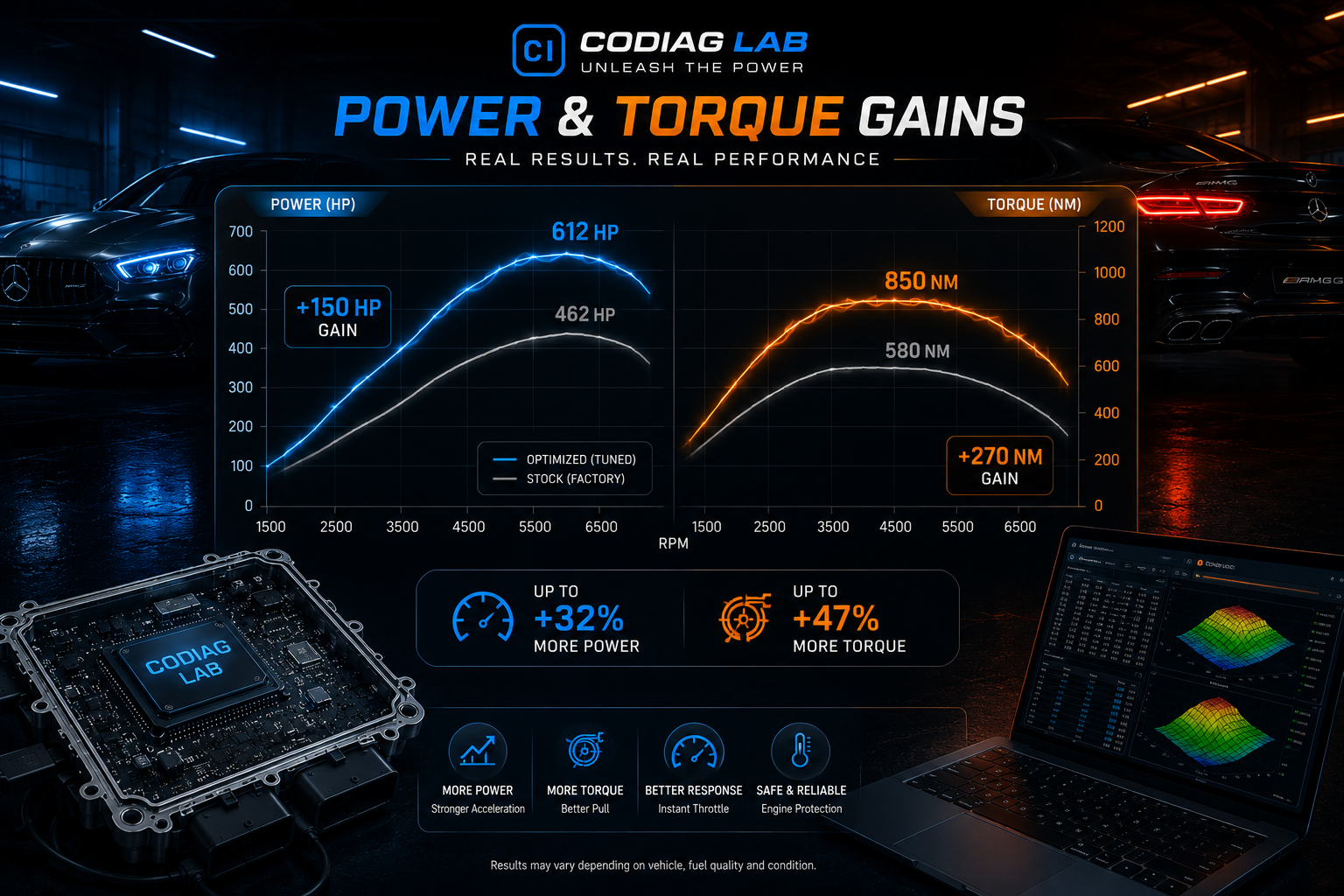
Instead of a plain table, each example is presented like a mini case card: stock output, tuned output and the actual gain the customer can feel on the road.

Power and torque before and after graph
Mercedes C220d
2.0L Diesel • Stage 1
+41 HP
Power 194 HP 235 HP
Torque 400 Nm 500 Nm
Power gain+41 HP
Torque gain+100 Nm
BMW 530d
3.0L Diesel • Stage 1
+55 HP
Power 265 HP 320 HP
Torque 620 Nm 700 Nm
Power gain+55 HP
Torque gain+80 Nm
Audi A6 3.0 TDI
V6 Diesel • Stage 1
+54 HP
Power 286 HP 340 HP
Torque 620 Nm 720 Nm
Power gain+54 HP
Torque gain+100 Nm
VW Golf GTI
2.0 TSI • Stage 1
+55 HP
Power 245 HP 300 HP
Torque 370 Nm 440 Nm
Power gain+55 HP
Torque gain+70 Nm

Figures are typical examples. Actual results depend on engine condition, software version, fuel quality, hardware configuration and diagnostic status.

Professional workflow

A clean process from inspection to delivery

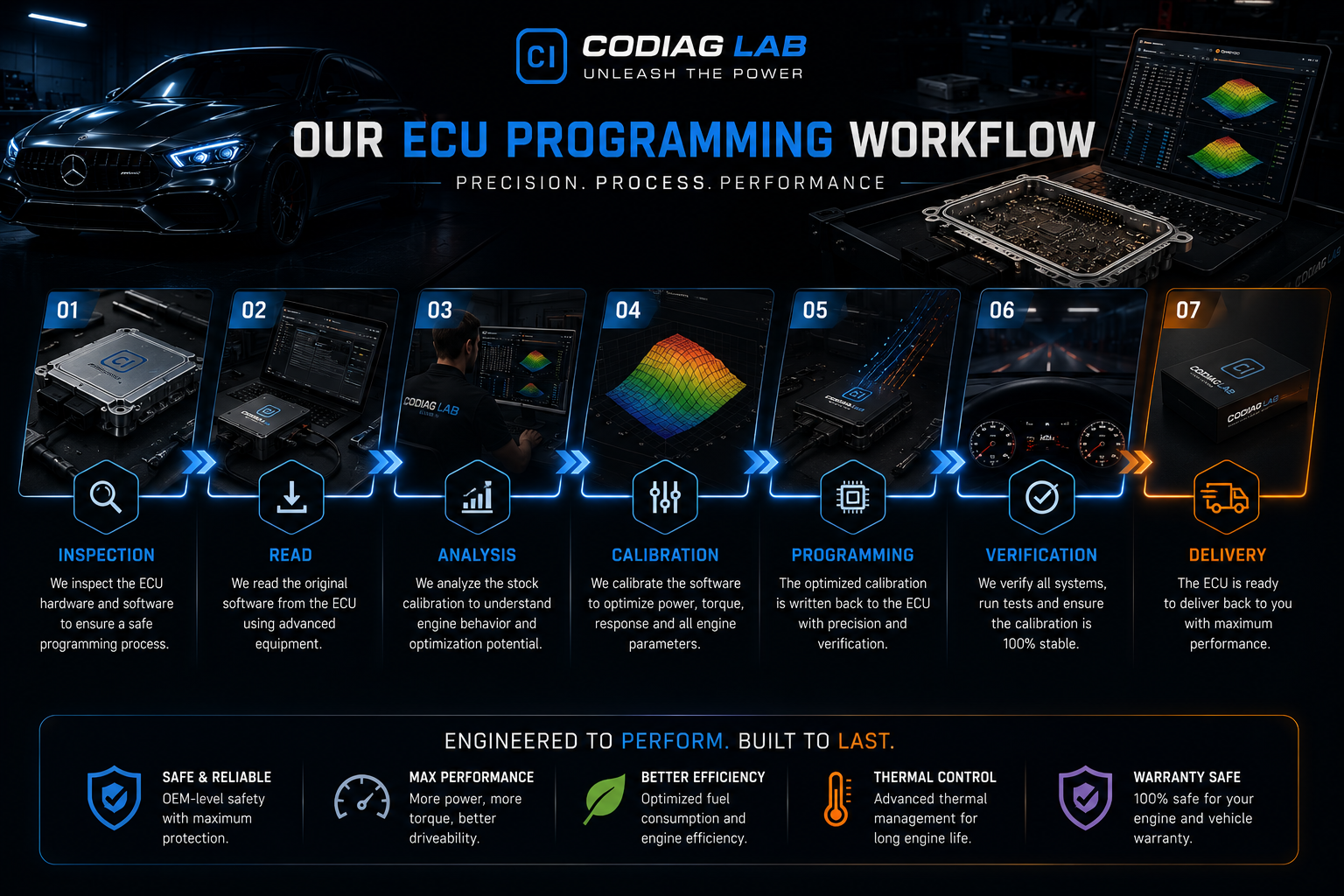
ECU tuning is not only writing a file. A professional workflow protects the original software, verifies vehicle health and keeps the result consistent.

ECU programming workflow
InspectionFault memory and vehicle health check
ReadOriginal ECU data extraction
AnalysisSoftware and calibration review
CalibrationSafe map optimization
ProgrammingWriting optimized software
VerificationDiagnostic checks after write
DeliveryFinal review with the customer
ECU tuning safety and reliability
Safety & reliability

Performance without unnecessary risk

Good ECU tuning is not about pushing every value to the maximum. It is about improving the useful performance window while respecting engine temperature, turbocharger limits, torque management and transmission safety.

Critical protection strategies remain active. The aim is a vehicle that feels stronger, cleaner and more responsive in daily driving — not a calibration that looks impressive for a few minutes and creates problems later.

Thermal protectionTorque managementSafe boost targetsTransmission awareness
FAQ

Common ECU tuning questions

Clear answers before booking. The goal is simple: more performance, clean diagnostics and a calibration that makes sense for your vehicle.

01 Is ECU tuning safe for daily driving?

Yes, when the vehicle is mechanically healthy and the calibration respects engine, turbocharger and transmission limits. At Codiag Lab, the focus is not extreme numbers on paper, but reliable performance that feels stronger in real driving.

02 Can the original software be restored later?

In most cases, yes. The original ECU software is backed up before modification whenever the vehicle platform and programming method allow it. This gives us a clean restore point if the vehicle needs to return to factory calibration.

03 How much power can I expect?

Typical Stage 1 gains depend on the engine, turbocharger, fuel system and software version. Many turbo diesel and turbo petrol vehicles gain roughly 15–35% more power and 20–45% more torque, but the exact result is always vehicle-specific.

04 Does ECU tuning increase fuel consumption?

Fuel consumption depends mainly on driving style. During normal driving, the stronger torque can sometimes reduce unnecessary downshifts and improve efficiency. Under aggressive acceleration, fuel consumption will naturally increase because the engine is producing more power.

05 Do I need hardware modifications for Stage 1?

Usually no. Stage 1 ECU tuning is designed for vehicles with standard hardware. It optimizes the existing engine setup without requiring upgraded turbochargers, injectors or internal engine modifications.

06 Is the gearbox considered during ECU tuning?

Yes. Torque delivery must be calibrated with the transmission in mind. Excessive torque requests can create unnecessary stress, especially on automatic gearboxes. A professional calibration improves performance without ignoring gearbox protection.

07 How long does ECU tuning take?

Most ECU tuning jobs take around one to three hours. Some vehicles require additional time if bench or boot mode reading is needed, or if the ECU software needs deeper analysis before programming.

08 What happens if my car has fault codes?

The vehicle should be diagnosed before tuning. Existing engine, boost, fuel or sensor faults can affect the result and must be understood first. Tuning is not a way to hide mechanical problems; it should be performed on a healthy base.

09 Can diesel and petrol vehicles both be tuned?

Yes. Turbo diesel engines often gain strong mid-range torque, while turbo petrol engines usually gain sharper response and higher peak power. The calibration strategy is different for each engine type.

10 What information should I send before booking?

Send the vehicle brand, model, year, engine, current power output if known, transmission type and a short description of what you want to improve. A photo of the registration document or VIN can also help identify the exact software platform.

Start your calibration request

Ready for more power, better response and a cleaner driving feel?

Send your vehicle details and we will review the available ECU tuning options, expected gains and the safest programming method for your car.

01Vehicle details
02Software review
03Safe calibration plan